Software Engineering Career Progression

Introduction
Your software engineering career is more than just writing code—it's a journey through distinct phases, each requiring different skills, mindsets, and approaches. Whether you're fresh out of college or contemplating your next career move, understanding the full landscape helps you navigate intentionally rather than accidentally.
This guide maps out the complete career progression for software engineers, covering both the Individual Contributor (IC) and Management tracks. We'll explore nine distinct levels spanning 15-25 years of career growth, from your first production code to leading organizations of hundreds.
What makes each level different isn't just scope—it's the nature of the work itself. You'll transition from completing tasks to leading projects, from writing code to influencing strategy, and from technical execution to business impact.
Let's dive into what awaits at each stage of your engineering career.
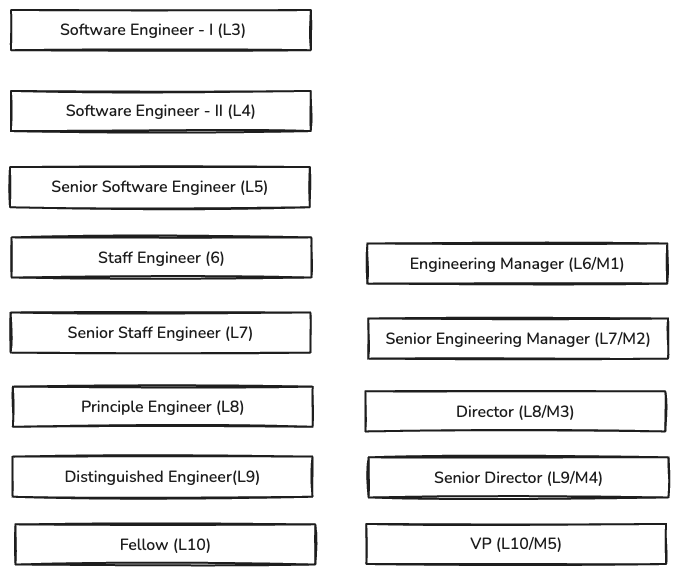
The Individual Contributor Track
Level 3: Entry Level Software Engineer
Who you are: You're not a complete novice. Most engineers at this level are recent college graduates with 1-2 internships under their belt, or professionals with 1-2 years at smaller companies. You have foundational knowledge but limited production experience.
What you do:
- Work on well-defined tasks: bug fixes, small features, adding tests
- Complete assignments within hours to days
- Tasks are defined and assigned by senior engineers or managers
- Focus on building fluency with languages, codebase, tools, and internal platforms
Key expectations:
- Ship code quickly and with quality
- Increase execution speed consistently
- Master the development environment and tooling
- Learn to navigate the codebase effectively
Reality check: Getting stuck is normal at this level. You might not even know what questions to ask, let alone whom to ask. Senior engineers are expected to unblock you regularly. This isn't a weakness—it's part of the learning process.
Timeline: Most engineers spend 1-2 years at this level.
Path forward: To advance, you need to take on small projects independently, breaking them down into tasks for yourself and sometimes others. These projects typically span a few weeks to a few months.
Common pitfalls:
- Struggling to solve problems with code quickly
- Requiring excessive guidance from senior engineers
- Discovering that 4-6 hours of daily coding is mentally exhausting
- Some engineers realize they prefer less code-heavy roles and transition to Program Management or Product Management
Level 4: Mid-Level Software Engineer
Who you are: You have 2-5 years of work experience, or you're a newly-graduated Ph.D. without significant industry background. You're comfortable with the basics and ready to own more complex work.
What you do:
- Own well-scoped projects (not just tasks)
- Projects span weeks to months
- Work includes new features and complex bug fixes requiring significant refactoring
- Serve as project lead, breaking work into tasks for yourself and teammates
- May work solo or collaboratively
Key expectations:
- Continue building technical fluency across the stack
- Ship quality code consistently to production
- Develop independence and self-unblocking skills
- Rarely get stuck for extended periods
- Ensure your projects stay on track
New challenge: Project management For many engineers, project management is entirely new at this level. It's often the biggest struggle area. You're no longer just writing code—you're coordinating work, managing dependencies, and keeping projects moving forward.
Timeline: Expect to spend 2-3 years mastering this level.
Path forward: Advancement requires taking on larger, more complex projects that demand significant collaboration across multiple teams. These projects last 6-12 months and demonstrate your ability to:
- Become a Subject Matter Expert in specific domains
- Get consulted before major technical changes
- Develop an intuitive sense of quality standards
- Mentor other engineers effectively
Level 5: Senior Software Engineer
Congratulations—you've reached the pinnacle of hands-on development. With roughly 5-10 years of experience, you possess deep tacit knowledge of how software is actually developed, tested, and deployed at scale.
What you do:
- Work on complex, ambiguous, innovative projects
- Projects span 6-12 months and involve multiple engineers across different teams
- Still spend the bulk of your time coding
- Demonstrate project ownership from conception to launch
- Mentor other engineers
- Participate in interviewing and recruiting
Key expectations:
- Be highly efficient with your time
- Drive complex projects independently
- Make sound technical decisions with significant impact
- Build and maintain technical expertise
- Help others grow
The fork in the road: Many engineers remain at this level for a decade or more, and that's perfectly acceptable. The scale and complexity naturally increase over time, preventing stagnation. You have three paths forward:
- Deep Specialization: Become the go-to expert in a particular domain
- Breadth: Develop expertise across multiple areas through internal mobility
- Leadership Development: Build soft skills and transition to Tech Lead or Tech Lead Manager roles (managing up to 6 reports)
The soft skills reality: Even though you're coding most of the day, software is a team sport. Communication, leadership, influence, collaboration, and conflict resolution become increasingly important. Many brilliant engineers plateau here because they prefer working with code over working with people. There's no shame in this—you can build anything, have maximum internal mobility, and remain highly sought after by other companies.
Path forward: To reach Staff level (Level 6), you must master soft skills. Specifically:
- Effective communication and collaboration
- Building trust and influencing without authority
- Conflict resolution
These skills unlock your ability to lead progressively larger and more complex initiatives with company-wide impact.
Level 6: Staff Software Engineer
This transition is jarring. Each career level is a different job, requiring new skills while letting go of habits that made you successful. The shift to Staff is particularly challenging for two reasons:
- Soft skills become mandatory: Communication, leadership, influence, collaboration, and conflict resolution are no longer optional—they're the core of your role
- You might stop coding: You'll spend much of your day in meetings, and you may no longer be the most efficient hands-on coder on your team
What you do:
- Write design documents, emails, and presentations
- Lead complex projects spanning multiple functional areas
- Projects take 1-2 years to complete
- Require intense cross-functional collaboration
- Navigate conflicts and influence without authority
- Partner with Engineering Managers on performance evaluations
- Conduct extensive interviewing and mentoring
- May develop opinions on organizational structure and effectiveness
The "Architect" misconception: At some companies, Level 6 might be called an "Architect." But at leading tech companies, that title can carry a negative connotation—it implies designing without ensuring delivery. Drawing great plans isn't enough. Your projects must be:
- In production
- Operating at scale
- Delivering measurable value
- Clearly attributable to your leadership
You must gather the right people, get agreement, set direction, help prioritize, and ensure delivery.
External hire challenges: Joining at Staff level (or above) from outside is particularly difficult. Internal promotions have years of hands-on experience building systems at scale, plus extensive internal relationships forming the foundation of their credibility. As an external hire, you lack this credibility and won't have opportunities to build it through coding. Onboarding takes at least 6 months, and you must build trust through other means.
Timeline: This level prepares you for even larger scope and complexity at Level 7.
Path forward: Senior Staff Engineers (Level 7) tackle multi-year company-wide or industry-wide initiatives. They often have 10-20 years of experience and are well-known in their domains.
Level 7: Senior Staff Software Engineer
Understanding this role requires previewing Level 8: Principal Engineers are executives whose impact is measured in business terms, not just technical terms. Senior Staff expectations sit on a continuum between Staff and Principal.
What you do:
- Work at scales spanning cross-functional groups, entire business units, sometimes the entire company or industry
- Lead initiatives thinking 2-3 years ahead
- Serve as tech lead for specific product areas
- Function as deep subject matter expert in technical domains
- Rarely code—focus on long-term direction, mentoring, industry representation
- Often advocate for NOT building something or deprecating code to reduce complexity
The critical mindset shift: While Level 6 engineers view problems as sociotechnical, Level 7 engineers approach them as business problems sometimes solved with technology. You consider:
- Company priorities and strategic direction
- Competitive and regulatory landscapes
- Business fundamentals like ROI and P&L
- Technical decisions in the context of business outcomes
Key expectations: You must demonstrate even more effective soft skills than at Level 6. Your influence extends across the organization, requiring masterful communication, leadership, collaboration, and conflict resolution.
The common struggle: Showing direct, attributable impact. Many Level 7 engineers excel at architecture, communication, mentoring, or consensus-building. But if their work doesn't result in measurable technical or business outcomes that wouldn't have happened without them, they struggle to meet expectations.
Management option: You can move laterally into senior management (managing ~30 engineers), though some companies prefer this not be your first management role.
External hire reality: Joining at Level 7 or above is an adventure—like being dropped in a remote forest without a map or knowledge of the local language. Standard onboarding programs are informative but won't teach you how to do your job. Even with an experienced mentor, onboarding can take up to a year and isn't guaranteed to succeed. You might receive vague guidance like "build trust" with a long list of people, or "go slow to go fast," without clear direction on how to execute.
Levels 8-10: Principal, Distinguished Engineer & Fellow
Welcome to the top 0.5%. You've become an executive, joining the most influential, visionary, and deeply technical leaders in your company and industry.
Level 8: Principal Engineer
The fundamental shift: While Level 7 engineers solve complex technical problems, Principal Engineers solve business problems. Success isn't measured in elegant code but in:
- Company and market impact
- Revenue generation
- Cost reduction
- Risk mitigation
What you do:
- Set product-, division-, or company-wide technical direction
- Make decisions impacting billions of users and billions of dollars
- Spend days in meetings, reading and writing documents (rarely code), and mentoring
- Work with hundreds of engineers and executives across the company
- Operate primarily through influence
- Ensure engineering teams build the right things
- Prevent teams from building the wrong things
The context requirement: You need enormous company context to be effective at this level. You're making decisions with massive implications, requiring deep understanding of business strategy, technical architecture, and organizational dynamics.
Level 9: Distinguished Engineer
Your domain is no longer just the company—it's entire industries.
What you do:
- Don't just adopt industry standards—you create them
- Shape the future and steer your company toward it
- Work on the company's most existential technical business problems
- Possess enormous breadth and depth
- Influence technical direction of huge parts of the company and industry
- Embody company culture and values at the highest technical level
- Create scope and clarity for senior engineers to do career-defining work
- Serve as force multiplier, making entire engineering organizations more effective
The reality: Given the company context required, it's rare to see Distinguished Engineers with less than 10 years of tenure. Most are home-grown; external hires at this level are extremely rare.
Level 10: Fellow
There are only a handful of Fellows at major tech companies. "Fellow" is formal recognition that an engineer's contributions have already fundamentally altered the course of the company or industry.
Examples of Fellow-level impact:
- Foundational distributed systems (MapReduce, Bigtable)
- Revolutionary ML frameworks (TensorFlow)
- Core internet protocols
- Technologies that changed how millions of developers work
What you do:
- Operate outside the official career ladder
- Pursue long-term technical vision with minimal bureaucratic overhead
- Define company's technical strategy
- Think decade+ ahead
- Work on problems that will shape the industry's future
The reality: This isn't a position you apply for—it's recognition for work you've already done that fundamentally changed the technology landscape.
The Management Track
Level 6 (M1): Engineering Manager
The shock: You've spent years mastering code and been "promoted" to Engineering Manager. Plot twist—it's an entirely different job. Your success is now measured by what your 8-12 person team can deliver.
The fundamental question: Is your team building the right things, at the right speed, with the right quality?
The Three-Part Role
1. The Backstop You fill gaps to ensure team success:
- No dedicated Product Manager? You define product direction
- Ineffective Tech Lead? You own technical strategy
- No Project Manager? You handle project management
- Even if all these roles exist, you're still accountable for what and how your team delivers
2. People Manager
- Regular 1-on-1s with every team member
- Set clear expectations and provide actionable feedback
- Make hiring and firing decisions
- Monitor and maintain team health
- Conduct performance reviews (consuming 20%+ of your time)
3. The Glue
- Build relationships across the company
- Give and receive feedback effectively
- Resolve conflicts
- Influence without authority
- Support tech leads who may lack soft skills
What Success Looks Like
- Strong manager ratings from your team
- Solid retention rates
- Consistently growing people to Staff level (Level 6 IC)
- Built reputation for running a high-performing team people want to join
- People follow you to your next team
- Most importantly: Your team is delivering
Common Failure Modes
1. Inexperience: With less than 5 years of management experience, you haven't seen everything. Having experienced mentors is critical.
2. Too removed: Not deeply connected to your team's day-to-day work. You should have bandwidth to understand every aspect of your team's efforts.
3. Too in the weeds: Micromanaging instead of delegating and providing growth opportunities. You become a bottleneck rather than an enabler.
4. Single point of failure: Everything depends on you. Progress stops when you're on vacation—or worse.
5. Team monoculture: Only one type of person succeeds on your team. This is a long-term liability that limits your team's effectiveness and innovation.
Path to Level 7 (M2): Senior Engineering Manager
Your focus expands from line management to organizational leadership. The coordination overhead grows, and relationships with other teams become critical. You're:
- Growing senior talent: Getting an engineer or manager promoted to Level 6 becomes a key milestone
- Growing your team: Beginning to have other managers reporting to you
- Growing your scope: Focusing less on what's best for your team, more on what's best for the broader product area
Level 7 (M2): Senior Engineering Manager
The reality check: You're running a $15M business. With 20-50 people in high-cost areas, that's $8M-$20M per year in compensation alone.
The Delegation Paradox
You can't have 50 one-on-ones weekly—you must delegate. But finding the right balance is critical:
Delegate too little:
- Stay "in the weeds"
- Become a bottleneck and single point of failure
- No time for strategy or long-term thinking
Delegate too much:
- Make multi-million-dollar decisions without adequate context
- Operate in the dark
- Lose touch with reality on the ground
Finding the balance between these extremes is key to success at this level.
The Shift: From Expert to Professional Manager
At Level 6 (M1): Your technical subject matter expertise was crucial
At Level 7 (M2): Management IS your subject matter expertise
- You're managing roles you've never held yourself
- You must performance-manage and grow people in unfamiliar disciplines
- Can you effectively manage without first-hand experience in those roles?
Your mindset shifts from:
- Knowing all the answers → Knowing the right questions to ask
- Making decisions → Connecting the right people to make decisions
- Relying on people → Relying on processes and systems for consistent results
- Efficient work allocation → Efficient capital allocation
- What's best for your team → What's best for the broader product area
Building Your Organization
While juggling daily operations, you're building the next generation of leaders and intentionally designing the organization.
You're shaping the organization through:
- Building sustainable location and level strategy
- Eliminating single points of failure
- Developing succession plans
- Leading without authority across peer Engineering teams, as well as Product, Site Reliability, and Program Management functions
Success measure: Getting engineers and managers promoted to Level 6 becomes a key indicator of your effectiveness.
The Uncomfortable Truth
When companies eliminate management layers, Level 7s are often the first to go.
The best managers prepare for this reality by:
- Building resilient teams that can thrive without them
- Cultivating strong professional networks internally and externally
- Developing recruiting capabilities
- Preparing for their own next role
This reality also builds your own resilience, forcing you to maintain connections and options.
Next Level Preview: Director (Level 8)
Scope and complexity doubles, yet you still have only 24 hours in a day. You're running a 50-100 person business with a $20M-$50M budget. Your primary responsibility becomes efficient capital allocation for the company. You're the executive who can drop into any messy situation and make it better, quickly.
Levels 8-10: Director, Senior Director & VP
Make no mistake: You may have decades of technology and management experience, but you're now a business executive.
The Scope
Director (Level 8):
- Lead 50-100 people
- Manage $20M-$50M in compensation
Senior Director (Level 9):
- Lead 100-500 people
- Budgets reaching well into nine figures
VP (Level 10+):
- Lead larger, more complex organizations
- Some VPs are General Managers—essentially CEOs of their business areas
- Lead all functions (Engineering, Product, Sales, Support, etc.)
- Responsible for full P&L (Profit and Loss)
What You Manage
1. Portfolios You manage a multi-disciplinary mix of teams (Engineering, Product, Site Reliability, Data Science, Sales, Support) to solve business problems on behalf of the company.
2. Risk You balance multiple dimensions of risk:
- People risk
- Product risk
- Regulatory risk
- Reputation risk
- Revenue risk
3. Relationships Succeeding requires building strong relationships with senior leadership. Your work must be both impactful AND visible.
Your Mindset Shifts From:
- Knowing the right questions to ask → Building systems (e.g., regular reviews) and relationships that surface business signals automatically
- Connecting the right people to make decisions → Quickly resolving escalations when they reach your level
- Letting the work "do the talking" → Effective communication strategy ensuring visibility and impact
- Efficient capital allocation → Managing full P&L with complete business accountability
- What's best for a product area → What's best for the company as a whole
The Executive Test: Can You Fix Anything?
You must be able to quickly improve any situation:
- Performance crisis in any part of your organization
- Complex legal case in an unfamiliar jurisdiction
- Building cross-industry partnerships with competitors
- Revenue problems, quality problems, people problems
- Organizational restructuring (layoffs, offshoring, reorganizations)
The expectation: Even with decades of experience, you'll face scenarios you've never encountered. Figure it out within weeks or months.
Watch What You Say and Do
People pay extremely close attention to your words and actions.
Questions to consider:
- Are you extolling work/life balance while sending late-night emails? Your team will model your behavior, not your words
- Has your team not internalized a message you've repeated for months?
- Has an off-hand comment become the stated reason the team reprioritized work?
Your responsibilities:
- Clearly message priorities and expectations
- Model desired behaviors consistently
- Reward the behaviors you want to see more of
- Recognize that everything you do sets the tone for your organization
Politics at Senior Levels
At Senior Director and above, politics becomes a necessary tool. This isn't about scheming or "empire building."
Politics is about:
- You and your fellow Directors/VPs collectively running the company
- Building alliances to accomplish shared goals
- Navigating complex organizational and interpersonal dynamics
- Understanding that major decisions happen in informal conversations, not just formal meetings
- Never going into a big meeting without knowing its likely outcome
Why trust and relationships are essential:
- Technical excellence alone isn't enough
- You must build coalitions to drive change
- You need allies who will support your initiatives
- You're operating at a level where perception and relationships matter as much as execution
Key Takeaways: Navigating Your Career
1. Each Level Is a Different Job
Don't expect to do the same work with more scope. Each promotion fundamentally changes what you do and how you're evaluated. The habits that made you successful at one level may actively hinder you at the next.
2. The Technical-to-Leadership Spectrum
Your career isn't linear—it's a spectrum:
- Early levels (3-5): Deep technical execution
- Mid levels (6-7): Technical leadership with increasing soft skills
- Senior levels (8-10): Business leadership with technical foundation
3. The Soft Skills Inflection Point
Soft skills become mandatory at Level 6 (Staff or Engineering Manager). Communication, influence, collaboration, and conflict resolution aren't optional "nice-to-haves"—they're the core competencies that determine your success.
4. Staying vs. Moving Up
Staying at Senior Engineer (Level 5) for your entire career is not a failure. You can:
- Build anything
- Have maximum mobility within and across companies
- Remain highly sought after
- Avoid the stress of constant people management
- Focus on what you love: solving technical problems
5. Management Is Not a Promotion
Moving into management isn't a promotion—it's a career change. You're not a "senior" engineer managing others; you're a beginning manager who happens to have engineering background. The skills are different, the work is different, and the satisfaction comes from different sources.
6. External Hiring Gets Harder
Joining at senior levels (6+) from outside becomes progressively more challenging. You lack the internal credibility, relationships, and company context that home-grown leaders possess. Onboarding takes 6-12 months and requires different strategies than technical excellence alone.
7. Impact Becomes Everything
As you advance, the question shifts from "Did you write good code?" to "Did anything meaningfully change because of you?" You must demonstrate:
- Direct attribution to business outcomes
- Results that wouldn't have happened without your leadership
- Measurable impact on company success
8. The Myth of Work-Life Balance
Each level brings different stresses:
- Junior levels: Impostor syndrome and technical inadequacy
- Mid levels: Juggling technical work and leadership
- Senior IC levels: Influence without authority, strategic ambiguity
- Management levels: People problems that can't be "solved" with code
- Executive levels: High-stakes decisions with incomplete information
Choose the type of stress you can handle, not the level that sounds most impressive.
Final Thoughts
Your software engineering career is a journey of continuous reinvention. Each level requires you to learn new skills, adopt new mindsets, and often let go of things you've mastered.
The key is intentionality. Don't climb the ladder because it's there—climb it because you're genuinely excited about the work at the next level. Talk to people one or two levels above you. Understand what their days actually look like, not just what the job description says.
Remember: There's no single "right" path. A 20-year career as a Senior Engineer building incredible software is just as valuable as becoming a VP. The best career is the one where you're energized by your work, continuously learning, and making meaningful impact.
Where are you in your journey? What level resonates most with where you want to go?
The map is here. Now it's up to you to choose your path.